Nearing the end of World War II, many Luftwaffe units were involved in ground combat. Hermann Göring omitted the request from the German Army (Heer) to transfer personnel from various Luftwaffe units by creating Luftwaffe Field Divisions with light infantry and artillery battalions as early as October 1942. A total of 22 Divisions were created or planned by the end of World War II.
Paratroopers would get involved more frequently in man-to-man combat based on the lack of offensive operations and jumps towards the end of the war. The formation of Luftwaffe Panzer troops, eclipsing in the Fallschirm-Panzer-Division "Hermann Göring", unique for being the Luftwaffe's only true panzer division, blended paratrooper ethos with heavy armor and fighting across WWII on multiple fronts. While the Wehrmacht (Army) had its own dedicated Panzerwaffe (Armored Force) with black uniforms and pink insignia, the Luftwaffe's "HG" division, named after Hermann Göring, served as an elite, combined-arms force with tanks, infantry, and artillery, often recruited from Hitler Youth and later even Army troops, acting as shock troops and holding key sectors.
The award system of the Luftwaffe did not have any designated medals or decorations that were designed specifically for those tasks. The pilot's badge was designed as a proficiency badge for operating airplanes; an equivalent for a tank commander did not exist, and, contrary to the proficiency badge, had to be earned through continuous combat.
The Luftwaffe personnel operating similar tasks to their Army colleagues depended, therefore, on the line-up of awards issued through the Army. Luftwaffe personnel would be awarded Tank Battle badges and Close Combat Clasps just like them, except for the Luftwaffe Ground Combat Badge[1], issued on March 31, 1942, just before the creation of the Luftwaffe Field Divisions.
Only from November 3, 1944, on would there be Luftwaffe-specific equivalents to those Army War badges and clasps. Hermann Göring ordered the creation of the Close Combat Clasp and the Tank Battle Badge of the Luftwaffe.
The order, published in "Luftwaffe Ordinance Gazette, Volume 10, Berlin, November 20, 1944, 49th edition.“[2] reads as follows:
"Ordinances and orders of the R.d. L. and the O. K. L.
The Reich Marshal of the Greater German Reich and Commander-in-Chief of the Luftwaffe
1574. Ordinance on the introduction of a hand-to-hand combat clasp and a tank combat badge of the Luftwaffe
The increasing use of air force units, especially parachute troops, in the ground battles of the defensive fronts and at the focal points of the current war, as well as the way in which they participate in these battles, gives me reason to approve the introduction of further combat insignia for the Air Force.
Based on the combat insignia introduced by the army, I donate as a visible sign of recognition for brave behavior in combat with bare weapons and hand-to-hand weapons, and at the same time as an incentive to fulfill the highest level of duty the "Close Combat Clasp of the Luftwaffe"
and for probation in combat when serving as members of Tank, Tank Reconnaissance, and Tank Support Troops units of the Luftwaffe the "Tank Battle Badge of the Luftwaffe".
The award of these combat badges of the Luftwaffe shall be made in accordance with the following provisions. The supervisors responsible are tasked with ensuring that the award regulations are strictly adhered to.
Implementing regulations are issued by the Chief of Personnel, Armament, and National Socialist Leadership of the Air Force. Headquarters of the Ob. d. L., November 3, 1944.
Göring“
The regulations specifically for the "Close Combat Clasp of the Luftwaffe" are as follows:
“I
"Close Combat Clasp of the Luftwaffe"
1. The "Close Combat Clasp of the Luftwaffe" can be awarded to all members of the Air Force who have repeatedly proven themselves in hand-to-hand combat with a weapon in their hands in accordance with their task.
The ground combat badge of the Luftwaffe is awarded independently of this if the required conditions are met.
2. The "Luftwaffe Close Combat Clasp" is awarded in 3 levels, i.e. in bronze, silver, and gold. Like the Squadron clasp, it is to be worn 1 cm above the buckle of the order in and out of service. When the higher level is acquired, the previous one must be discarded and returned.
3. The conditions for the award are:
for the 1st level in bronze 15 Close Combat days
for the 2nd level in silver . 30 Close Combat Days
for the 3rd level in gold .. 50 Close Combat Days
4. All days of combat on which the combatants to be awarded had the opportunity to see the white in the eye of the enemy, i.e. to stand with the opponent in hand-to-hand combat with the opponent in hand-to-hand combat days are to be counted as days of hand-to-hand combat.
Hand-to-hand combat of this kind can occur in a large-scale attack, in a scouting expedition, in defense, in a single reporting round, when encountering an enemy scouting party, etc. The location, whether at the battle outposts, or in the Main Combat Line, in the artillery firing position, in the rear area of operations (also partisan area), or in the event of an enemy attack on a supply column, etc., is irrelevant.
5. Every soldier who has had to endure such hand-to-hand combat unprotected and on foot and has proven himself is a candidate for the hand-to-hand combat clasp.
6. The regimental commander responsible for or higher troop superiors with equal powers shall, on the proposal of the unit leader, determine in the daily order the day of close combat to be credited for the units involved. The unit leader shall submit the necessary proposals without delay, if possible, on the same day, with the daily report.
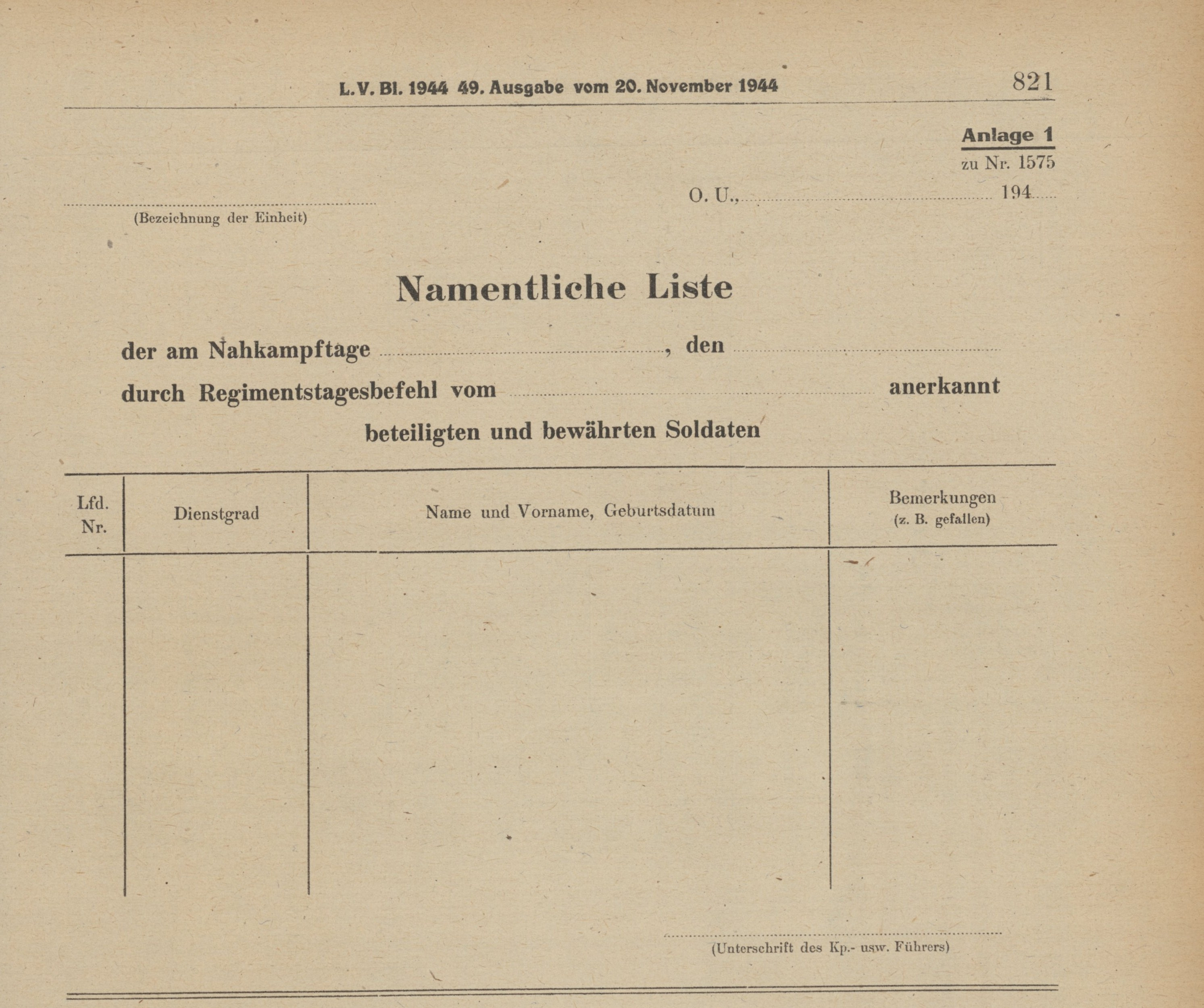
At the same time as submitting the proposal for the recognition of the local combat day, the unit leader shall determine in a list (sample Annex 1) the names of the soldiers participating in the hand-to-hand combat day and proven soldiers. The list of names shall bear the signature of the unit leader and be stamped. The lists are to be enclosed with the war diary.
Soldiers of other units who took part in the fighting, etc., are to be included in the lists. Corresponding excerpts are to be forwarded to the units of these soldiers. The determination of the hand-to-hand combat days to be credited for members of higher staff and offices directly subordinate to them who are not part of the regimental, etc. association, as well as for units and soldiers assigned from the regimental etc. unit, shall be determined by the tactical superior with the authority of at least one regimental commander.
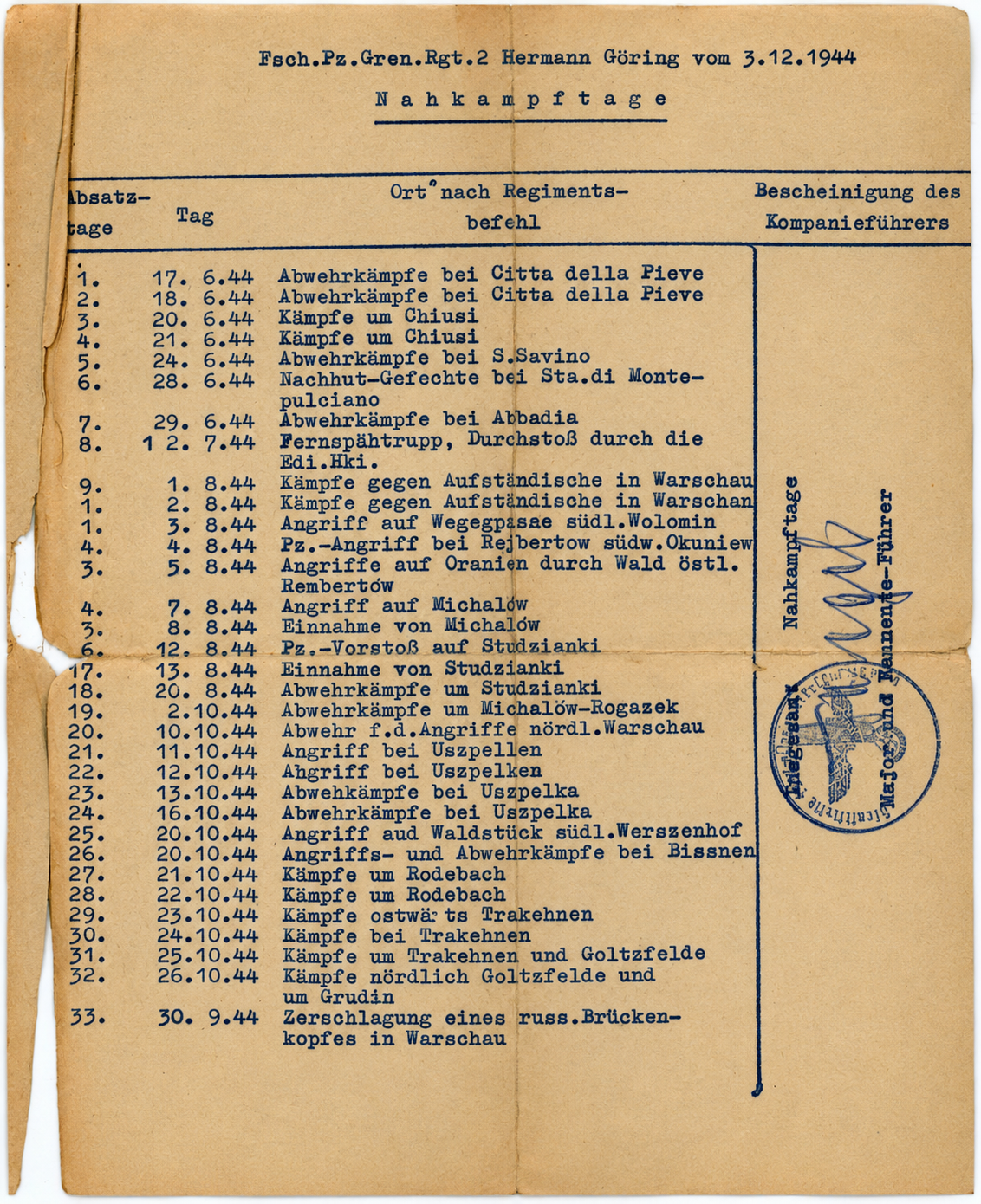
7. Each soldier must carry a sheet of paper (sample Annex 2) in the pay book on which the day of close combat to be credited is entered and certified.
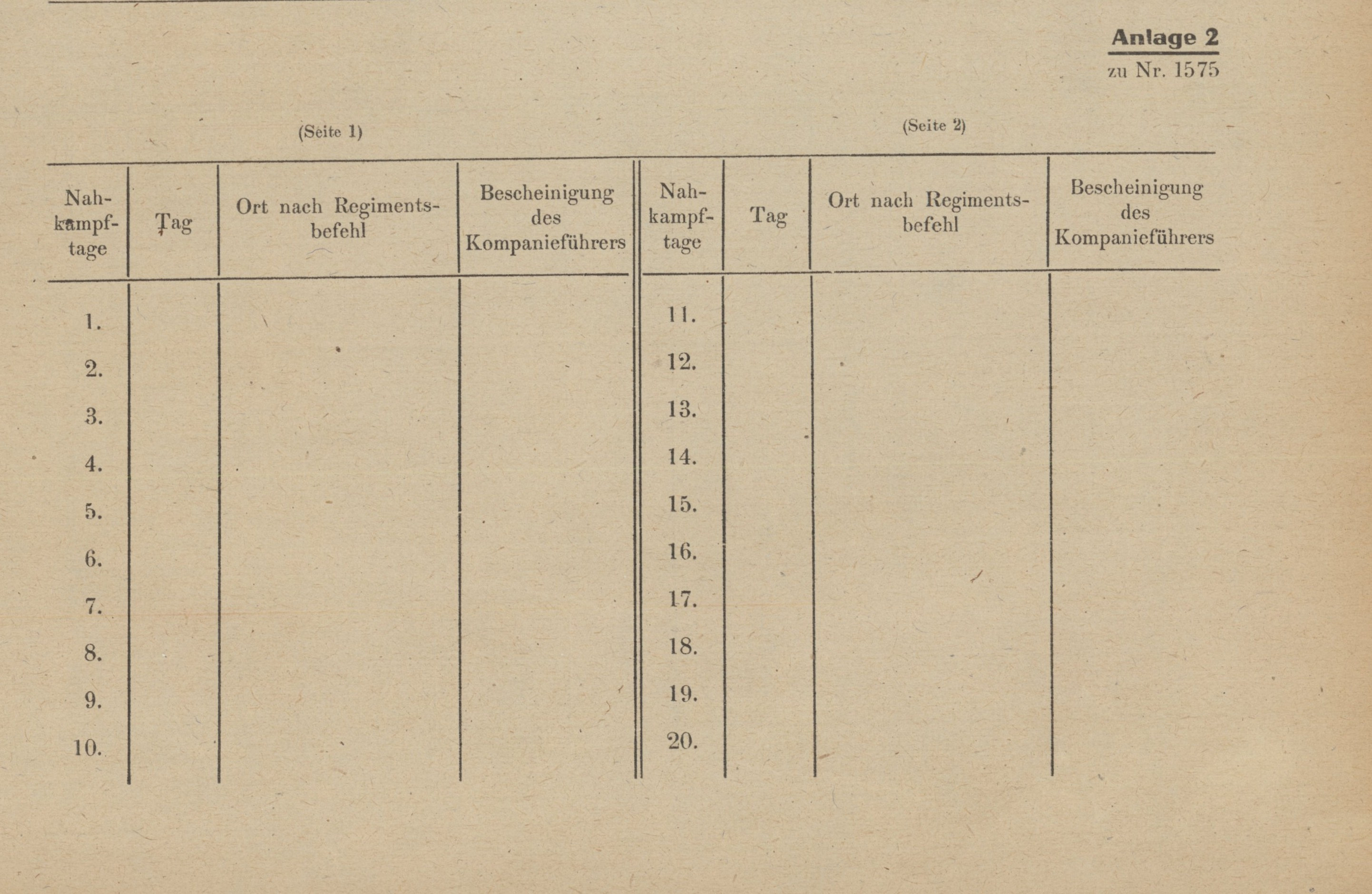
For the unit leaders from Company Leader upwards, the day of hand-to-hand combat must be certified by the next higher superior responsible for the respective assignment, and the corresponding duplicate must be kept with the personal papers.
8. Close combat days can be credited retroactively from January 1,1944, within the framework of the above provisions. The crediting of combat operations from further back in time for the award of the "Close Combat Clasp of the Air Force" is not permissible.
9. Soldiers who have been taken prisoner of war or are missing lose their entitlement to the "Luftwaffe hand-to-hand combat clasp".
10. In the event of departure from the troops, etc., due to wounding, illness, or transfer, a certificate of the hand-to-hand combat days that have been participated in and recognized so far must be attached to the transfer papers. In this certificate, the recognized hand-to-hand combat days must be listed individually.
11. Description of the "Luftwaffe Close Combat Clasp":
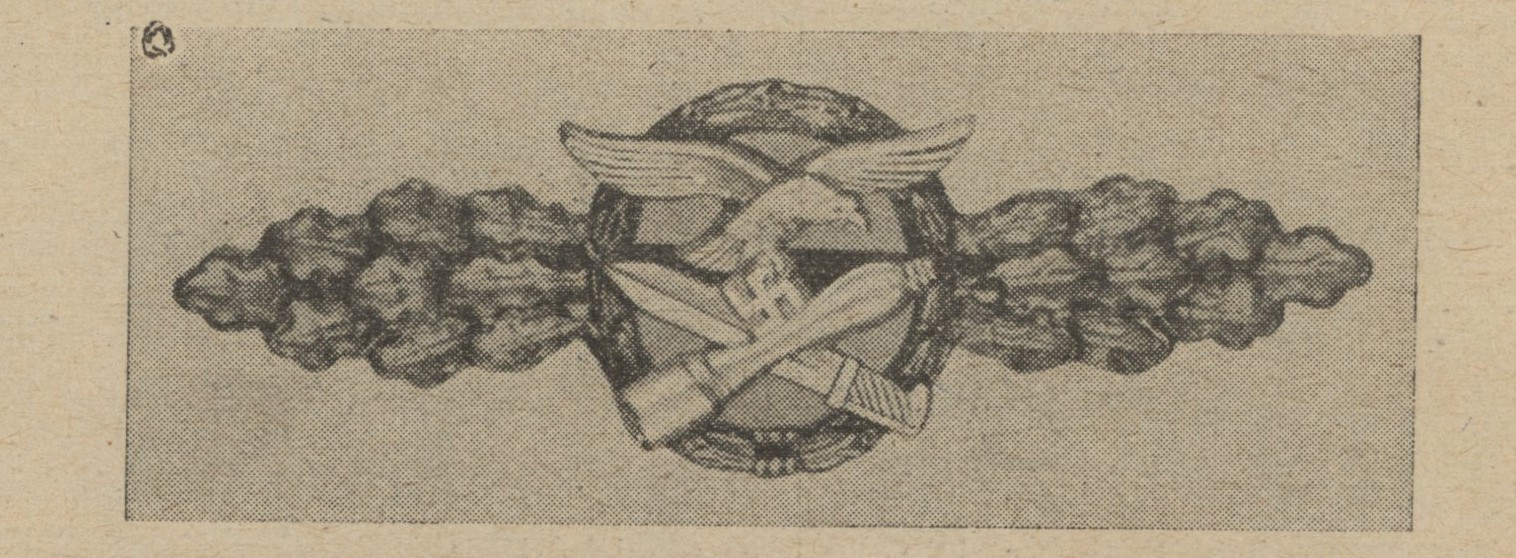
A massive oak leaf clasp with a laurel wreath, in the lower part of the middle piece, a hand grenade and a bayonet crossed, above it the emblem of the Luftwaffe.
On the back of the close combat clasp is a soldered hinge pin.
Design execution:
a) tombac, gilded,
b) nickel silver,
c) Tombac, bronze colored.
To a, to c: hand grenade, bayonet, and emblem in matt silver.
Dimensions: Length of the clasp in total about 75 mm, diameter of the laurel wreath about 25 mm.
[…]
III.
General Provisions
1. The awarding of the "Close Combat Clasp of the Luftwaffe" in bronze, silver, and gold, […], is carried out by the responsible regimental commanders or troop superiors with the same powers.
The tactical superiors with the powers of at least one regimental commander shall be responsible for awarding the award to members of higher staff and to offices directly subordinate to them that are not part of the regimental etc. association, as well as to members of the regimental etc. association of assigned units and to individually assigned soldiers.
The award to commanders - from the independent battalion or department commander upwards and higher troop superiors - is made exclusively by the Commander-in-Chief of the Parachute Army or the Commander-in-Chief of the Air Fleets. It must be clear from the applications for the award that the provisions for the award have been fully complied with.
2. The Reich Marshal personally reserves the right to hand over the "Close Combat Clasp of the Luftwaffe" in gold as the highest combat decoration for infantry service introduced in the Luftwaffe.
Soldiers who have fulfilled all the conditions (50 hand-to-hand battles until the final decision) are to be named by the Commanders entitled to award the award to the O.K.L. (Chief of Awards and Discipline) through official channels. For this purpose, a copy of the application for the award of the 3rd level of the "Close Combat Clasp of the Luftwaffe", on which the award by the commander concerned must be certified, must be submitted. The time of the report to the Reich Marshal is ordered on a case-by-case basis. It is particularly pointed out that a particularly strict standard must be applied when crediting the hand-to-hand combat days according to the foundation deed in order to maintain the high value of this award.
3. The “Close Combat Clasp” […] is only awarded to individuals.
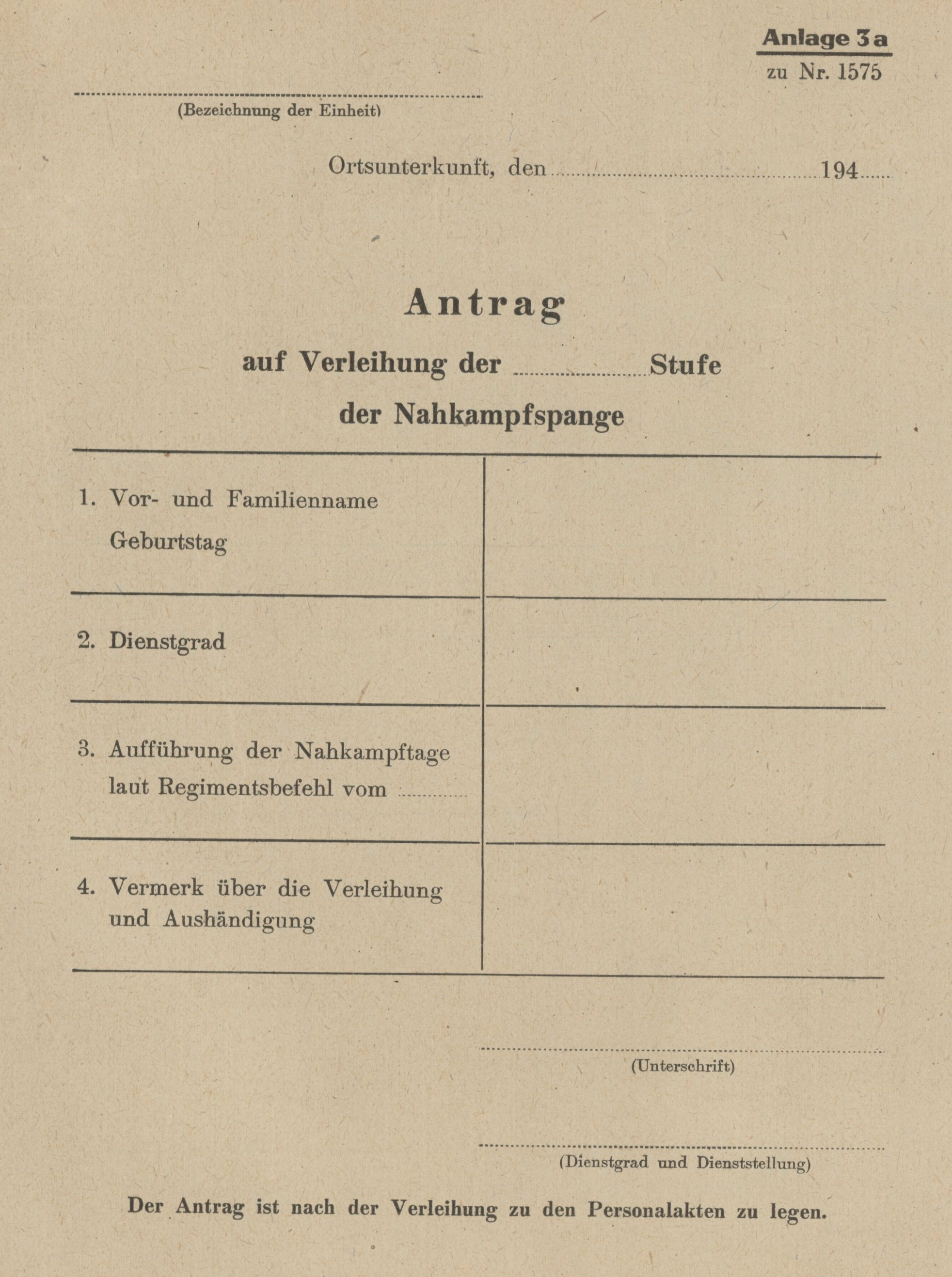
4. The Unit Commander applies to the regimental commander, etc., for the award of the appropriate level of the "Close Combat Clasp of the Luftwaffe" […] (III. I.). Applications must be submitted through official channels using forms in accordance with Annex 3.
5. Certificates of possession shall be issued by the awarding commanders in accordance with Appendix 4 for the awarding of the badges. The award is made in the name of the Commander-in-Chief of the Luftwaffe.
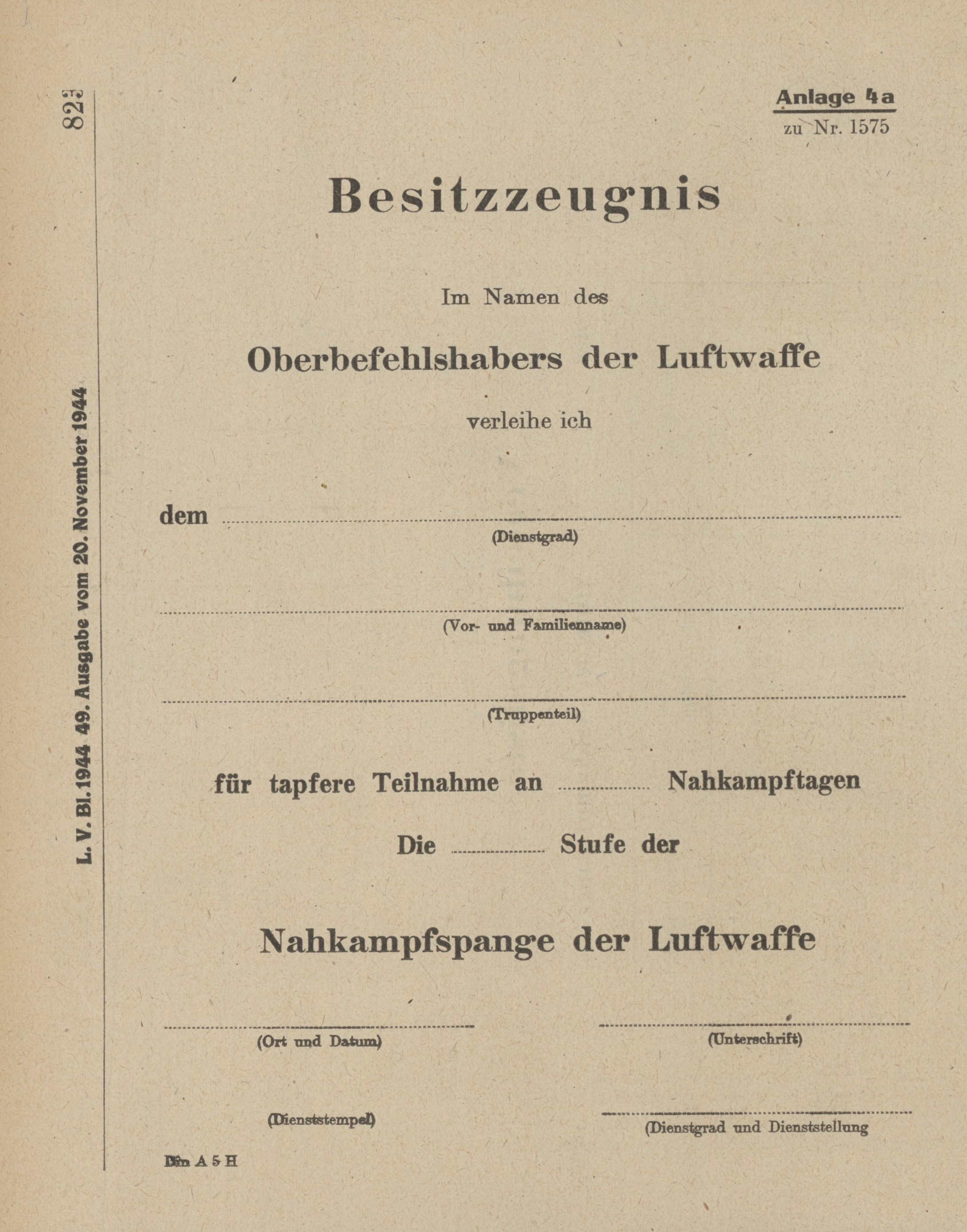
6. [..] badges can also be awarded to the fallen, the deceased, and the fatally injured. if they meet the conditions before death or on the day of their death. The award is to be sent to the surviving dependents with an award document.
7. The award is to be recorded in the personal papers leading in the war (pay book, military record, war record roll).
8. The awarding offices shall draw up award lists in accordance with Annex 5 for the awards made to "Close Combat Clasps of the Luftwaffe". These award lists are to be forwarded directly to the O.K.L. (Chief of Awards and Discipline) at intervals of 3 months at the latest.
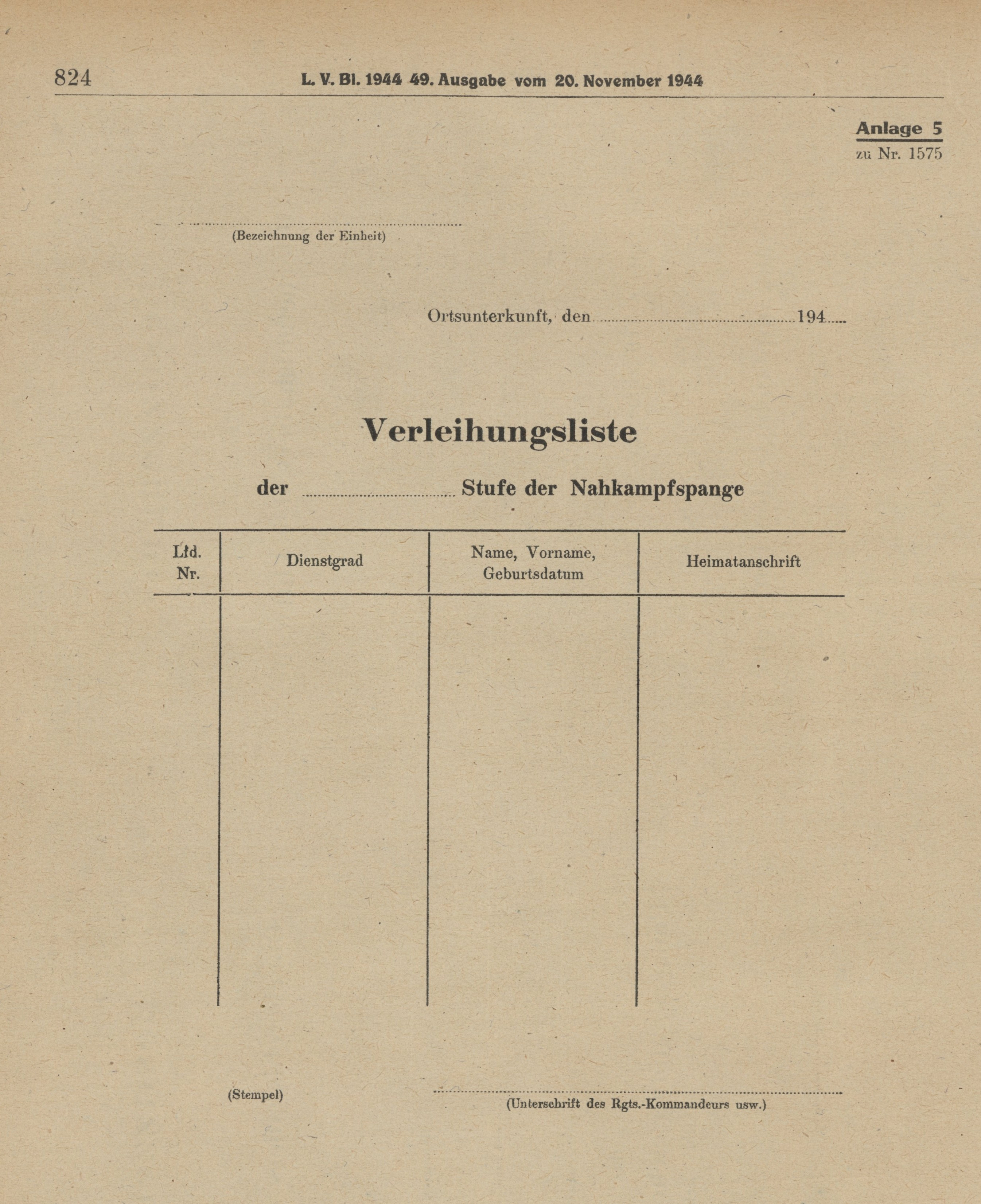
9. The badges awarded are delivered free of charge.
10. Additional copies and replacements for lost badges are to be purchased from the Air Force Sales Department upon presentation of the certificate of possession, a certified copy thereof, or a certificate from the office with an official stamp.
11. The insignia may be worn with all uniforms of the Armed Forces, the Party and its branches, and with civilian clothing, even in a reduced form.
12. Only the holder of a certificate of possession is entitled to wear the badge awarded. Any unauthorized wear is punishable by law.
13. The "Close Combat Clasps of the Luftwaffe" […] enjoy the criminal protection of the weapon insignia of the Wehrmacht in accordance with § 4 of the Ordinance on the Protection of the Weapon Insignia of the Wehrmacht of May 3, 1942.
14. The badges shall remain in the possession of the recipient after leaving active military service.
15. The awarding offices cover their requirements for hand-to-hand combat clasps and tank combat badges of the Luftwaffe by means of the official clothing supplies channels. Requirements are to be made to the locally competent “Luftgaukommando” (administration).
16. Award documents and, if applicable, application forms in accordance with annexes are to be procured by the awarding offices themselves.
Headquarters of the Ob. d. L., November 3,1944.
The Chief of Personnel Armament and National Socialist Leadership of the Luftwaffe Loerzer
Generaloberst
Announced.
O. K. L., November 10,1944,
Az. 29 e (Chef f. Ausz. u. Diszipl. I).“
This established the basis for the active award of the Luftwaffe “Close Combat Clasp,” beginning no later than late November or early December 1944, with close-combat days counted retroactively from 1 January 1944.
The Allied invasion on 6 June 1944 marked a decisive turning point in World War II. Confronted with a war on two fronts against an enemy with virtually unlimited manpower and material resources, the German Army was forced to commit all remaining resources to this intensified conflict.
Following the Allied landings on June 6, 1944, the Luftwaffe’s role in Normandy rapidly shifted from air defense to desperate ground combat. While anti-aircraft (Flak) units and Luftwaffe field formations were already engaged, the worsening situation forced Germany to commit its most capable formations, including elite airborne and armored units. Among these, the 3rd Fallschirmjäger Division became one of the most important Luftwaffe formations committed to the battle.
Arriving in Normandy in mid-June 1944, the 3rd Fallschirmjäger Division was rushed into action as an emergency infantry force. It fought extensively in the bitter defensive battles around Carentan, Saint-Lô, and the Vire–Taute area, where its well-trained paratroopers earned a reputation for tenacity and effective small-unit leadership. Despite heavy losses, constant Allied air superiority, and severe supply shortages, the division repeatedly delayed Allied advances, often holding key terrain under overwhelming pressure.
The 3rd Fallschirmjäger Division initially fought alongside the 17th SS-Panzergrenadier-Division „Götz von Berlichingen“, and other Army units committed to containing the Allied breakout. While the Waffen-SS provided armored striking power and aggressive counterattacks, the Fallschirmjäger served as highly reliable defensive infantry, anchoring front lines and conducting stubborn rearguard actions. Together, these elite formations formed the backbone of German resistance in Normandy during the critical weeks following D-Day.
Although ultimately unable to stop the Allied advance, the 3rd Fallschirmjäger Division's performance exemplified the Luftwaffe’s continued ground combat role in 1944 and highlighted the increasing reliance on elite units—both Luftwaffe and Waffen-SS—to stabilize collapsing fronts in the final phase of the war.
In 1944, the combat history of the 3rd Fallschirmjäger Division was inextricably linked to the performance of its organic support units, including the 4./Fallschirm-Flak-Abteilung 3 (mot), which played a critical and often overlooked role during the Normandy campaign and the division’s eventual destruction.
Following the Allied landings in Normandy, the division was rushed north and committed beginning in mid-June 1944, initially to stabilize the rapidly deteriorating front south of Carentan and Saint-Lô[3]. Within this context, 4./Fallschirm-Flak-Abteilung 3 (mot) was deployed not only in its intended air-defense role but also increasingly as a dual-purpose combat unit, engaging both Allied aircraft and ground forces. Equipped with mobile light and medium Flak guns, the battery operated under constant pressure from overwhelming Allied air superiority, often firing continuously while on the move or from hastily prepared positions.
In the bocage fighting — the dense network of hedgerows enclosing small fields — , the battery’s guns were frequently used in a direct-fire role against Allied infantry, armored vehicles, and troop concentrations. As Allied fighter-bombers dominated the skies, the men of 4./Fallschirm-Flak-Abteilung 3 (mot) provided vital close protection for Fallschirmjäger infantry positions, command posts, and withdrawal routes. Their mobility allowed them to redeploy rapidly as the front shifted, often covering exposed flanks or sealing temporary gaps in the line. Losses were heavy, as Flak positions were prime targets for Allied artillery and air attack.
The battery suffered particularly severe casualties during Operation Cobra[4] in late July 1944. The massive Allied aerial bombardment shattered large parts of the German defensive system, and Fallschirm-Flak crews found themselves fighting in near-apocalyptic conditions. Guns were destroyed, vehicles abandoned, and crews decimated, yet surviving elements continued to fight in improvised groups, supporting the division’s rearguard actions alongside Army and Waffen-SS units, including elements of the 12th SS Panzer Division “Hitlerjugend.” In many cases, Flak gunners fought as infantry, defending key road junctions and delaying Allied advances to allow other units to disengage.
During the retreat toward Falaise[5], the remnants of 4./Fallschirm-Flak-Abteilung 3 (mot) were committed almost continuously. They used their remaining guns sparingly because of ammunition shortages, but their presence remained crucial in discouraging low-level air attacks during daylight withdrawals. Under these difficult circumstances, the 7th Army ordered II. Fallschirm-Korps to break out of the pocket.
The II. Fallschirm-Korps began its attempt at 2230 hours on August 19. Shortly after the assault commenced, the division commander, Generalleutnant Schimpf, was wounded, and General der Flieger Meindl, the corps commander, assumed personal command of the division. The division quietly slipped past the 1st Polish Armoured Division in small assault groups and reached the Dives River without major incidents.
After escaping the Falaise Pocket[6], the remnants of the 3rd Fallschirmjäger Division fought on while withdrawing to the German border, ending up in Aachen in September 1944. The division was rebuilt in Oldenzaal, Netherlands, from September 24 to October 5, 1944, before it fought through the struggle of the end of World War II. with its surrender[7] on April 15, 1945.
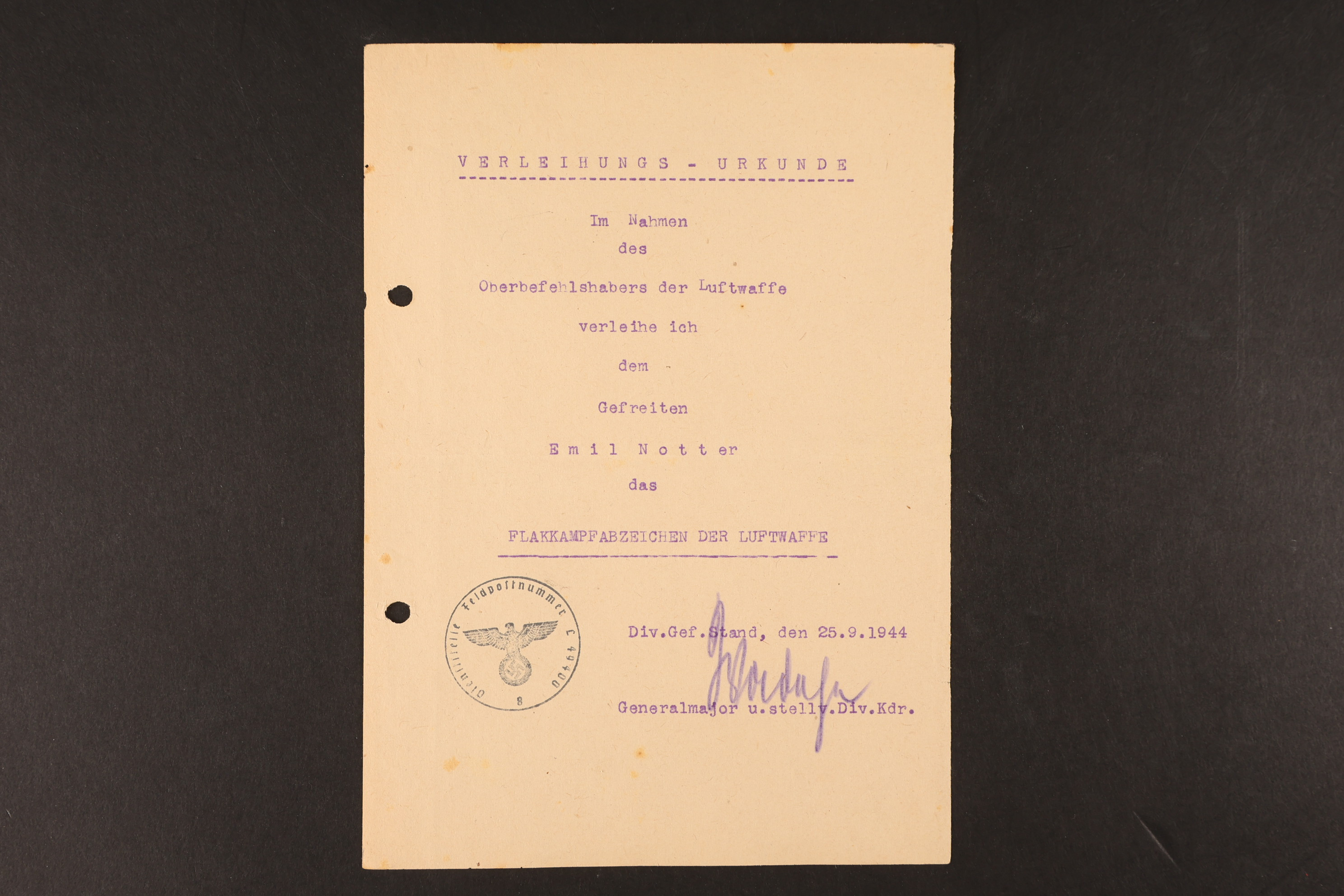
A notable member of the 4./Fallschirm-Flak-Abteilung 3 (mot.), as part of the 3rd Fallschirmjäger Division, was Obergrefreiter Emil Notter. He was awarded on September 25,1944, not only the “Flakkampfabzeichender Luftwaffe”, but the “Erdkampfabzeichen der Luftwaffe” during the Allied airborne landings in the Netherlands on September 17,1944, forming “Kampfgruppe 3. Fallschirmjäger-Division” under II. Fallschirmkorps. The unit fought southeast of Nijmegen, clearing scattered American paratroopers and, by 20 September, capturing the high ground northwest of Wyler alongside Kampfgruppe 5 of the 5th Fallschirmjäger Division. Over the following weeks, the Kampfgruppe defended the area against repeated American attacks.
Both typewritten award documents were signed in “Kopierstift” pencil by Generalmajor and Deputy Division Commander Walter Wadehn, who commanded the division from August 22, 1944, to January 5, 1945. The blue rubber stamp corresponds to the correct “Dienststelle Feldpostnummer L 49400 8”, used by the “Stab 3. Fallschirmjäger-Division” from September 8, 1943, to April 22, 1944.
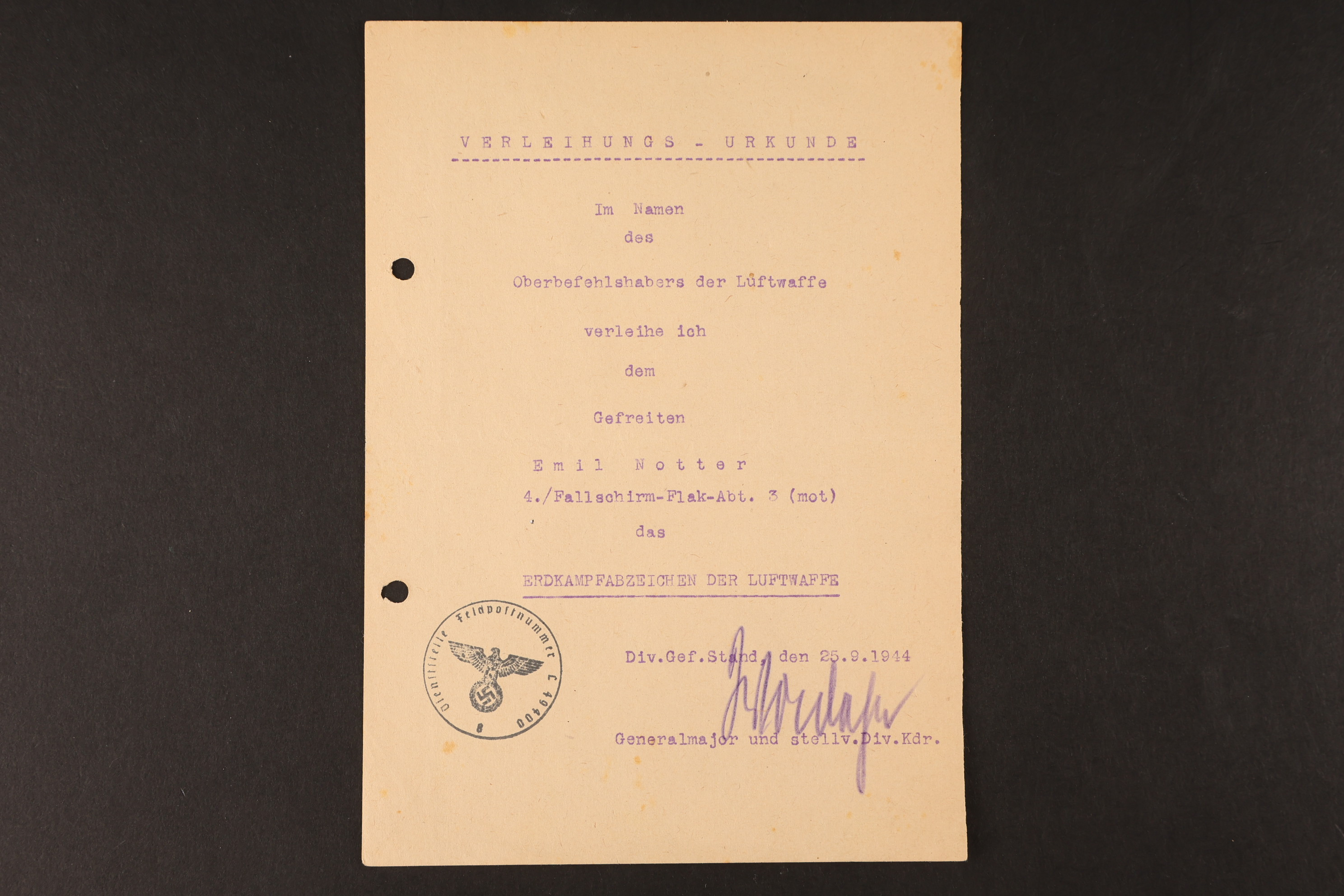
He was certainly involved in close combat action during those trying days as he was awarded the “Close Combat Clasp of the Luftwaffe” 1st grade on December 20 (with ink pen correction to 18), 1944, after the 1st U.S. Army launched a broad offensive on December 10 and breached the division line at Echtz were his division repelled additional attacks in the Hoven-Mariaweiler-Gürzenich bridgehead until being relieved by the 47th Volksgrenadier Division on December 13. Without pause, the division marched into the Eifel region to take part in the Ardennes Offensive, now under I. SS-Panzerkorps, penetrating American border defenses between Losheimer Graben and Manderfeld and advancing into positions held by the V U.S. Corps.
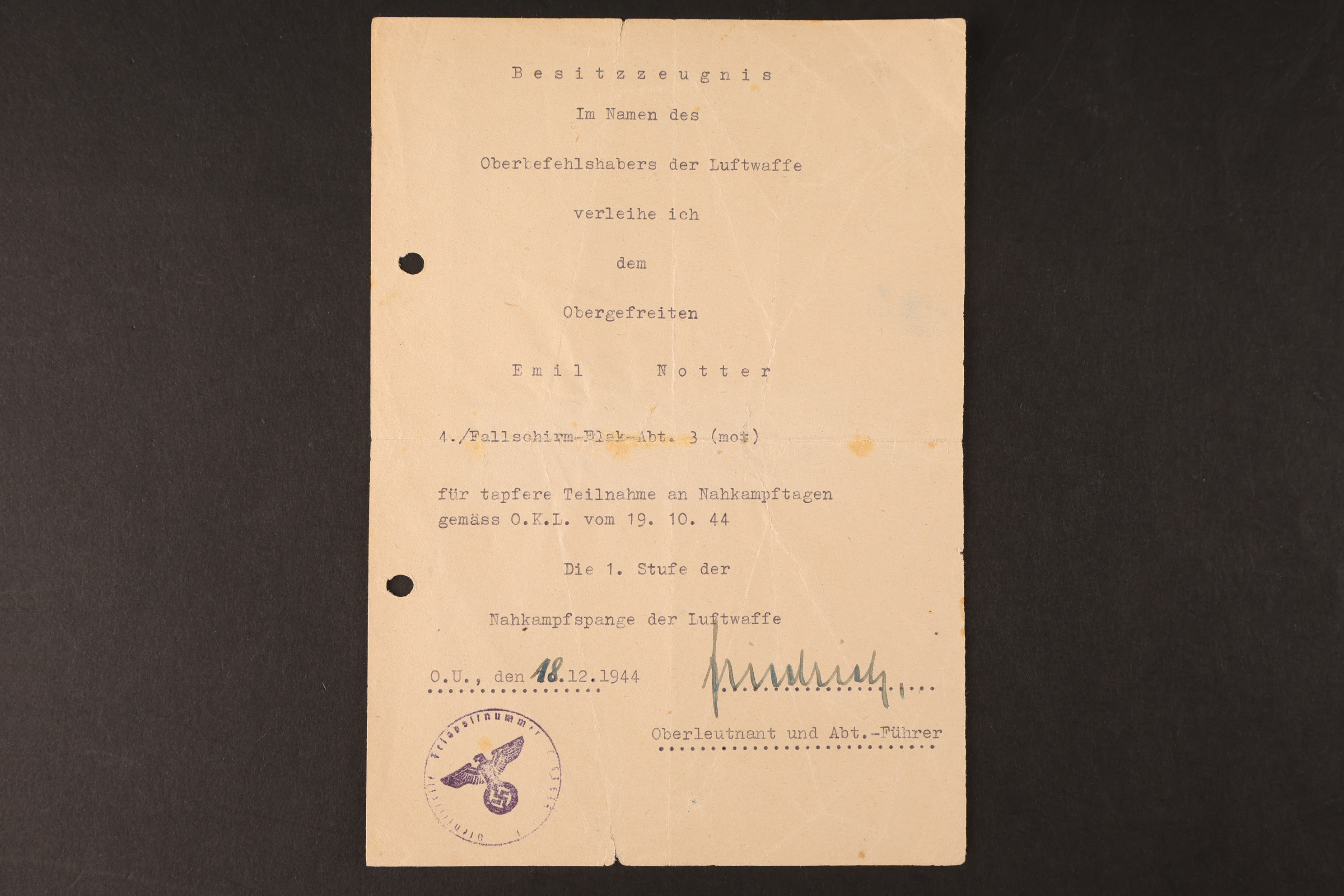
The typewritten award document was signed in ink pen by Oberleutnant and Abteilungsführer Friedrich. The blue rubber stamp corresponds to the correct “Dienststelle Feldpostnummer L 53635 1”, used by the “Stab Fallschirm-Flak-Abteilung 3” from December 1944 onwards.[8]
He never received the Close Combat clasp itself. Like many of these newly awarded badges from the last months of the 2nd World War, they never entered serial production. However, the award of the clasp took place, especially the 3rd grade as mentioned in Martin Dörr's book[9] , can be proven by still existing award certificates and pay book entries.
Especially in the Klietmann Archive[10], in the file on the "Close Combat Clasp of the Air Force", there is a small number of photocopies of original award certificates for close combat clasps of the Luftwaffe as well as letters and correspondence from contemporary witnesses who confirm the active awarding of the clasp in paper format, but deny the award of the actual clasp itself.
There are also various black-and-white photos of clasps. All the clasps photographed there are different from the ones shown in the Luftwaffe Ordinance Gazette and were classified by Dr. Klietmann as post-war productions.
However, the existence of contemporary photography in the Luftwaffe Ordinance Gazette 10th year, Berlin November 20, 1944, 49th edition, proves that at least one of these clasps must have existed at the time of printing. However, the clasp pictured there has never reappeared.
In contrast to the balloon observer badge or the low-flying aircraft destruction badge, the new combat badges of the Luftwaffe were much easier to design. In almost all cases, they were modifications of existing badges or clasps. It was only a small step from the anti-aircraft to the ground combat and ultimately to the tank combat badge of the Luftwaffe. Even the Luftwaffe's close combat clasp is a simple modification of the existing squadron clasps, with an easily achieved endorsement by Hitler due to its design proximity to the existing insignia.
Also interesting is the order from the Luftwaffe Ordinance Gazette published in January 1945, [11]:
"80. Exchange of the close combat clasp [...] of the Army into the close combat clasp [...] of the Luftwaffe
Reference: L.V.Bl. 1944, p.808, no. 1574.
For Luftwaffe members who have acquired the Army's close combat clasp [...], are ordered to exchange for the corresponding badge of the Luftwaffe.
The exchange must be certified on the back of the award certificate by the signature and official seal of the disciplinary superior. The personal papers are to be corrected. The insignia of the army is to be returned.
[…]
O.K.L, 13.1.1945
The 29e (L.P. Ausz. U. Dyspl./I B).
L.V. Bl. p. 47"
In this regard, one almost has to assume that the corresponding badges have already been ordered. The procurement process has certainly been initiated, according to German thoroughness. How far this process had progressed can certainly no longer be answered.
However, this order seems to have arisen from the embarrassing encounter between Hermann Göring and Oberleutnant Wilhelm-Werner Endres, company commander of the 7./Fallsch. Jäg. Rgt. 6. Endres was summoned to Göring for the award of the Luftwaffe 3rd level (gold) a few days earlier, on January 2, 1945, but Göring had to hand him one in the army clasps in the greatest displeasure, because the new version was not yet ready [12].
The outburst of anger that will certainly follow this embarrassing situation has certainly triggered pressure only on the procurement process that has already been initiated, but has certainly not produced any actual clasps as a result.
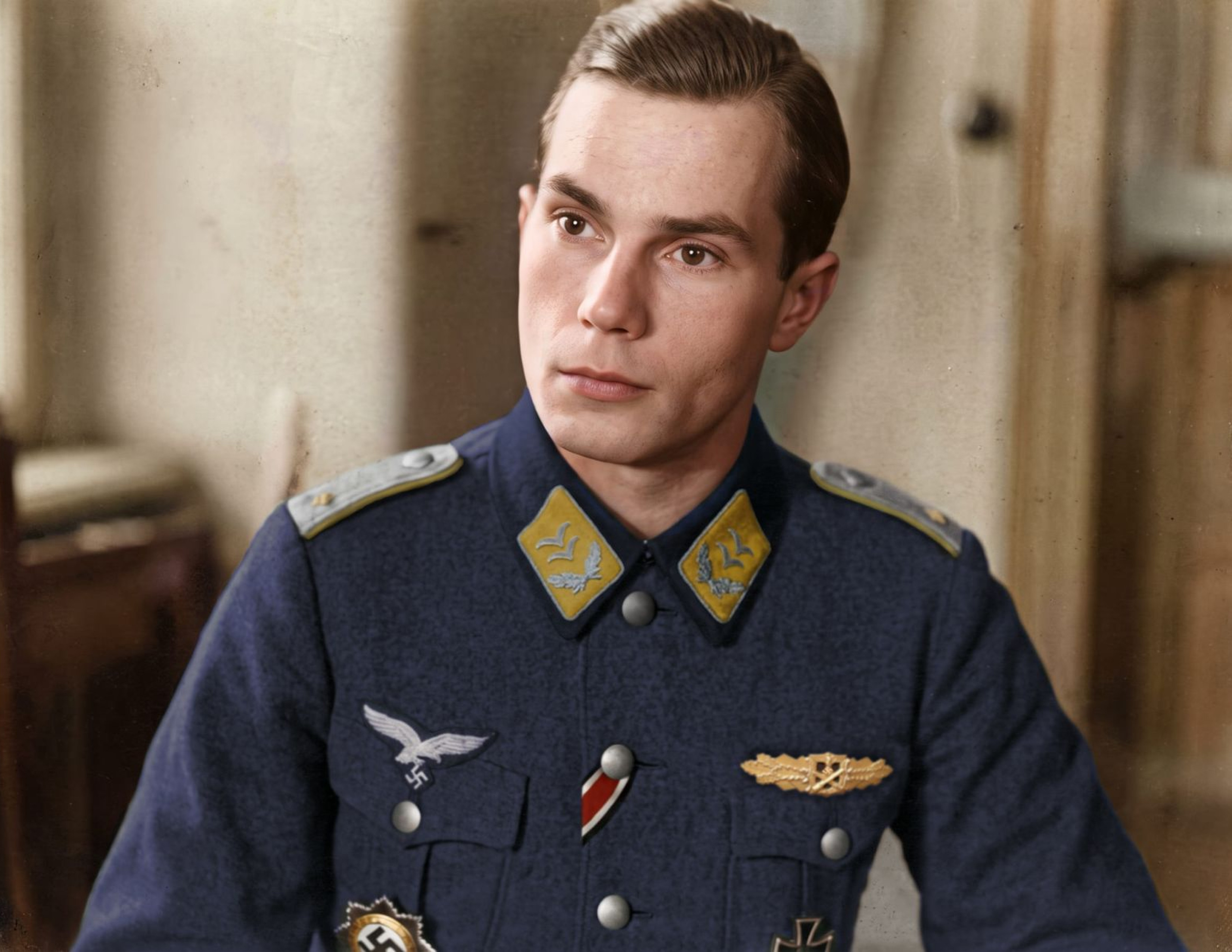
To the author's knowledge, no original serial produced close combat clasps of the Luftwaffe are known. Dr. Klietmann[13] had already established this in the 1960s.
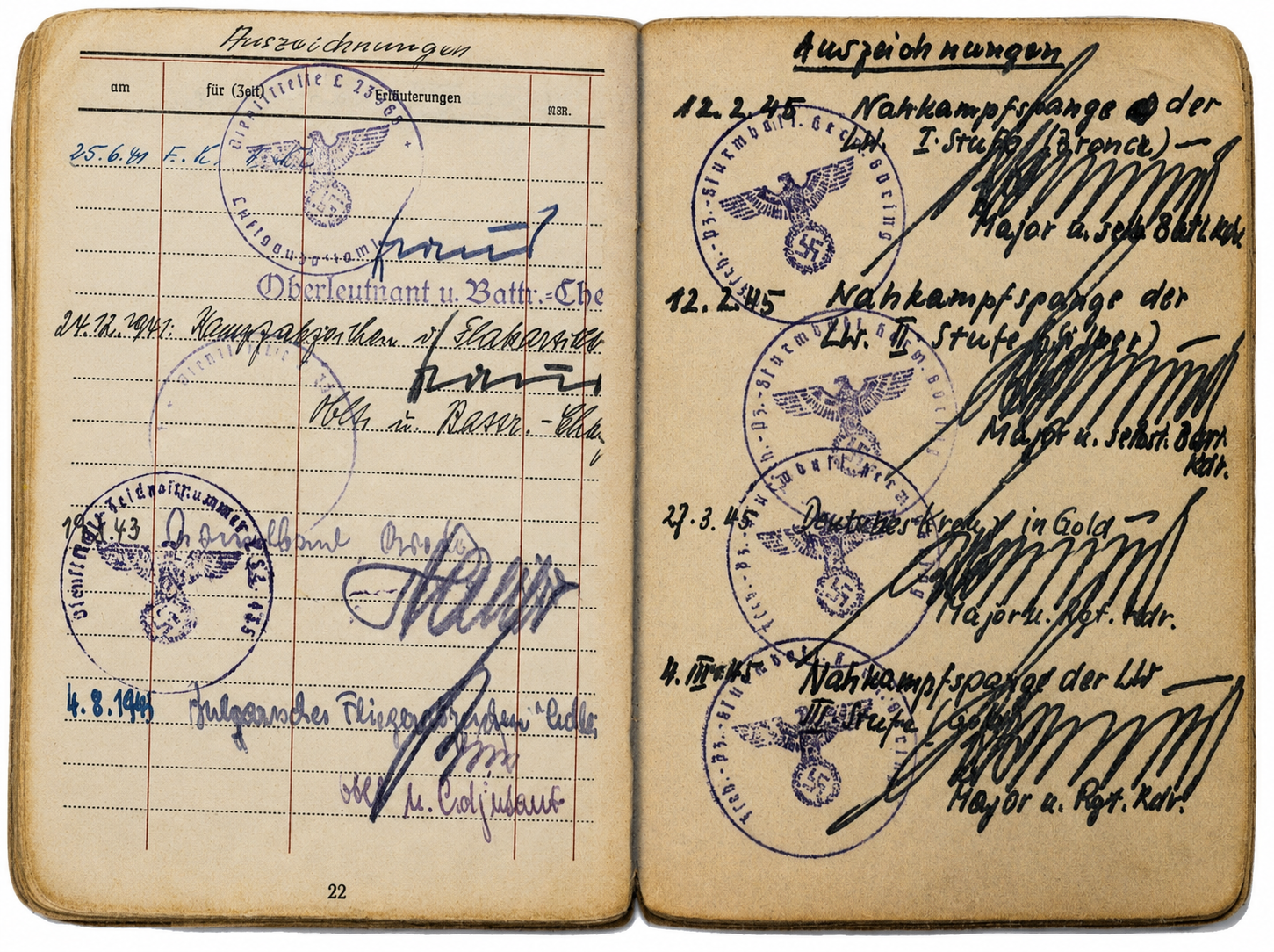
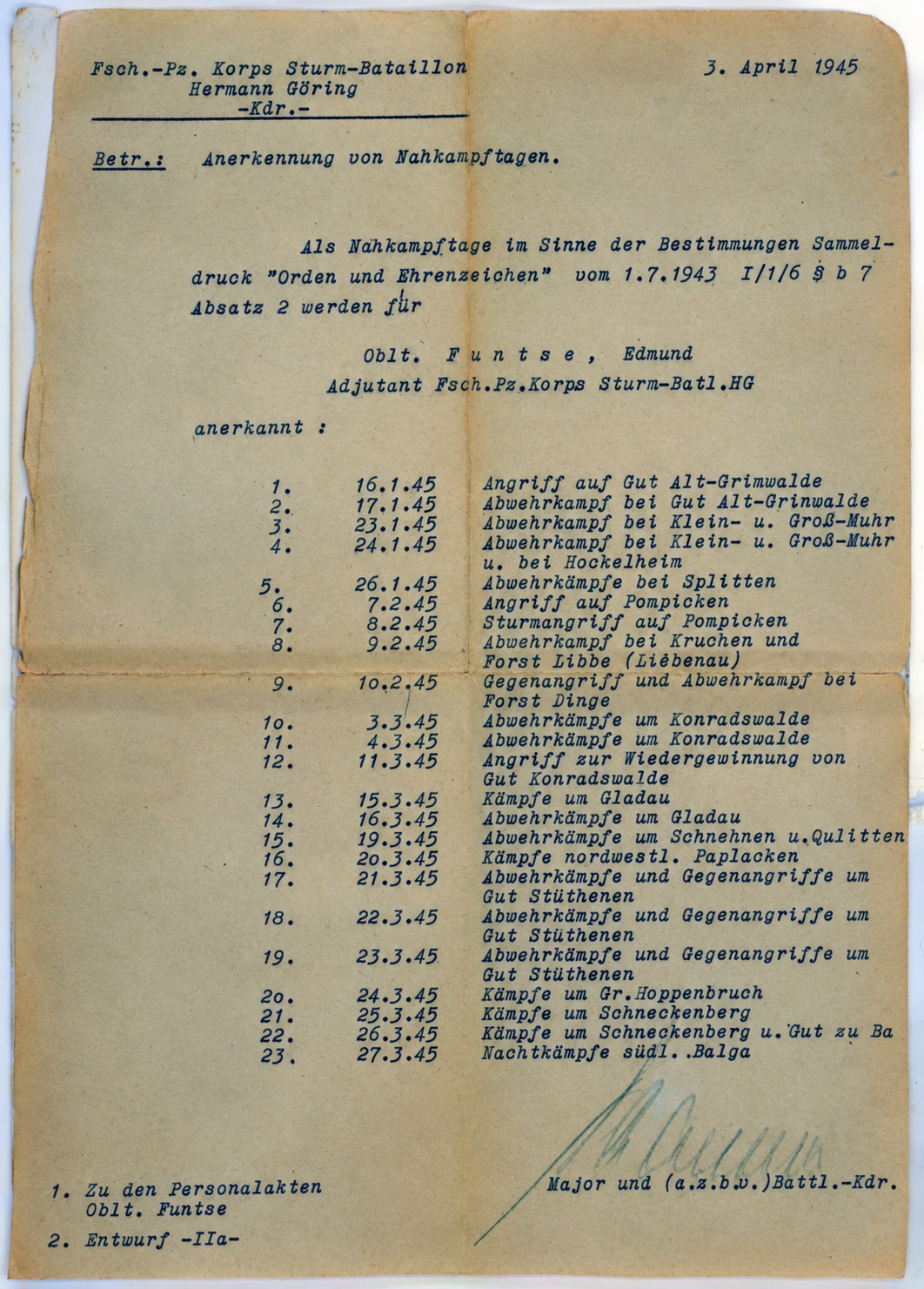
However, the Luftwaffe's close combat clasp was awarded and can be proven by award certificates and pay book entries that still exist today. Most of the awards were made in typewritten form, as in the case of Notter.
The Luftwaffe soldiers certainly did not lack opportunities to meet the requirements for the award of the clasp. Rather, in the last, increasingly hectic months of the war, they often lacked time to properly document the corresponding days of fighting and to deal with the associated bureaucracy in a timely manner.
In this context, corresponding documents are known, such as the pay book of Sergeant Alfred Hanitzsch. On April 5, 1945, he was awarded the bronze, i.e. the 1st level of the hand-to-hand combat clasp – remarkably, without the addition of "the Luftwaffe". Up to and including March 17, 1945, however, a total of 33 close combat days had already been entered in his pay book. This document thus proves that Luftwaffe soldiers could accumulate enough close combat days to meet the requirements for the award of the close combat clasp.
The surviving documents prove that all levels of the close combat clasp were awarded. The photo in the Verordnungsblatt [2] and the statement from Wilhelm-Werner Endres confirm the existence of the one prototype clasp [12].
Footnotes:
[1] The Ground Assault Badge of the Luftwaffe (German: Erdkampfabzeichen der Luftwaffe) was a Second World War German military decoration awarded to Luftwaffe personnel for participation and achievement in ground combat. It was instituted on March 31, 1942, by the Commander-in-Chief of the Luftwaffe Hermann Göring. The basic award criteria required participation in three separate ground combat operations on different days. Luftwaffe personnel who had previously received Army combat badges, such as the Infantry Assault Badge or the General Assault Badge, were required to exchange them for the Luftwaffe Ground Assault Badge. As the war progressed, it became necessary to distinguish those soldiers who had significantly exceeded the original award requirements. To address this, Göring introduced four higher numbered grades on 10 November 1944, based on the number of qualifying combat operations. These grades were identified by numerals incorporated into the base of the badge.
[2] “Luftwaffen-Verordnungsblatt, 10.Jahrgang, Berlin November 20, 1944, 49. Ausgabe”
[3] In July 1944, the 3rd Fallschirmjäger Division mounted a determined defense of St. Lô against the U.S. 29th Infantry Division and supporting armor. On 11 July, I Battalion of the 9th Fallschirmjäger Regiment launched a surprise night attack on the 1st Battalion, 115th Infantry Regiment, cutting communications and following up with artillery and mortar fire. The assault caused chaos among the Americans, delaying their planned offensive and inflicting heavy casualties, though it achieved little strategic gain. Over the following days, the Fallschirmjäger exploited the bocage terrain—the dense network of hedgerows enclosing small fields—to maximum effect. For the attacking Americans, progress was agonizingly slow: infantry had to hack paths through the thick hedges, expose themselves to well-positioned machine guns, and struggle to coordinate with supporting tanks and artillery. Tanks, constrained to narrow muddy lanes or forced to breach hedgerows, were vulnerable to mines, German guns, and ambushes. The hedgerows fragmented formations, isolated small units, and magnified the defensive advantage of the German paratroopers, who could fire from prepared positions, fall back, and quickly reoccupy successive lines. The fighting in the hedgerows was brutal, close, and disorienting, turning advances into a deadly series of small, contested gains. German counterattacks, often supported by armor, faced the same difficulties as the attackers and rarely achieved lasting breakthroughs. Despite this, the Fallschirmjäger were eventually pushed back by sustained American pressure. By 16–19 July, the 29th Infantry Division had cleared the German defenders from the approaches to St. Lô, forcing the paratroopers to withdraw to the heights east of the city, marking the end of organized German resistance in the immediate area. In essence, the hedgerow country amplified the tactical skill of the 3rd Fallschirmjäger Division, enabling small German units to inflict disproportionate casualties and delay a numerically superior force, even as the Americans gradually overcame the natural and man-made obstacles.
[4] Operation Cobra was a major American offensive launched by the U.S. First Army under Lt. Gen. Omar Bradley from 25 to 31 July 1944 during the Normandy campaign. Its objective was to break through the heavily defended German front south of Saint-Lô and end the stalemated fighting in the bocage. The operation opened with a massive aerial bombardment, followed by a concentrated ground assault by U.S. infantry and armored forces. Although the initial bombing caused some confusion on both sides, German defenses—already weakened and overstretched—collapsed under the sustained pressure. Once the breakthrough was achieved, American forces rapidly exploited the gap. Operation Cobra transformed the Normandy battle from static positional warfare into mobile operations, enabling a rapid Allied advance across France. Its success directly led to the German retreat and the eventual encirclement and destruction of large German forces in the Falaise Pocket, marking a decisive turning point in the campaign in Western Europe.
[5] The Battle of Saint-Lô left the 3rd Fallschirmjäger Division (3. FJD) with 436 killed, 1,513 wounded, and 136 missing in action—roughly 17% of the division’s strength. The survivors retreated toward Falaise, where they joined a II. Fallschirm-Korps rearguard under Eugen Meindl, along with the 2nd and 9th SS-Panzer Divisions under the overall command of SS-Obergruppenführer Hausser. The objective was to hold off encircling Allied forces and keep the narrowing corridor open as long as possible for retreating German units.
On the night of August 19–20, as the Falaise Pocket continued to shrink, Meindl withdrew to defensive positions around La Londe, south of the river Dives, in preparation for II. Fallschirm-Korps’ breakout. During the day, II. FK’s artillery expended its ammunition bombarding the enemy while Meindl assembled his troops in nearby woods. The plan was to abandon all heavy equipment and move on foot toward Hill 262, at the eastern extremity of the pocket, in single file in two groups, avoiding contact with the enemy. Meindl would lead one column, with II. FK Chief-of-Staff Oberst Blauensteiner leading the other. Soldiers were forbidden to fire until reaching the relative safety of Hill 262.
Hausser approved the plan and assured Meindl of support from the Das Reich and Hohenstaufen SS-Panzergrenadier divisions, which had already retreated east of the Dives. He planned to order them westward to link up with II. Fallschirm-Korps. What Hausser omitted to mention was that his two divisions had fewer than thirty serviceable tanks between them.
Throughout the long day of August 20, Meindl’s paratroopers and army comrades huddled in the woods, sharing the meager rations in their breadbags and smocks, waiting for the signal to move. Rain began to fall as they finally set out at 22:30. Despite efforts to avoid the enemy, several firefights occurred during the two-hour march to the Dives. Major Stephani, commander of FJR 9, was killed, and Schimpf was shot in the leg and had to be carried by his men. Meindl personally assumed command of the 3. FJD.
At dawn, as the rain subsided, Meindl observed Hill 262 through his binoculars. It was occupied by soldiers of the 1st Polish Armoured Division. The 2nd SS-Panzergrenadier Division had failed to capture it as Hausser had planned. Some Fallschirmjäger were preparing for a frontal assault on the hill when Meindl forbade it, ordering them to skirt around Hill 262 to the north to avoid direct confrontation.
Later on the morning of August 21, Meindl met Hausser in a bomb crater less than 2 km south of Hill 262. Hausser informed him that Das Reich was moving south to attack the hill’s northern slopes that afternoon and requested Meindl to organize a southern assault. By the end of the day, the main body of the 1st Polish Armoured Division was surrounded in the Hill 262 sector. Although the Poles held off German attacks, they no longer controlled the terrain between II. Fallschirm-Korps and Das Reich, and their ammunition was low. Thousands of German soldiers exploited the gap created by the encirclement to escape during the night.
Refusing to abandon his wounded, Meindl remained in the Falaise Pocket. The road to Coudehard offered the only escape but was under Polish artillery fire. Meindl gathered all available vehicles, marked them with large Red Cross flags, and split them into two columns. At 18:30 on August 20, 1944, he sent the first column down the road after halting all other traffic for twenty minutes. To his astonishment, the Poles held their fire. Half an hour later, the second column of wounded followed, and again no shots were fired. 3. FJD was all but destroyed at Falaise.
Eugen Meindl handed over command to Generalmajor Walter Wadehn on August 22, 1944.
[6] The 3rd Fallschirmjäger Division retreated northeast through Vimoutiers, Bernay, Brionne, Elbeuf, and St. Pierre, eventually reaching the Seine River by the end of August 1944. Despite heavy losses, the battered division was quickly reconstituted near Rouen and, by early September, assigned to serve as rear guard for the 5th and 7th Armies, holding the line from Crevecœur-le-Grand through Montdidier, Ham, and St. Quentin.
On August 4, 1944, the division was trapped in Belgium near Mons, and most of its forces were captured. Only small elements managed to escape, falling back through Charleroi, Nivelles, Wavre, and Maastricht to Aachen, before regrouping east of Cologne near Leverkusen, Burscheid, and Opladen in mid-September.
The division was immediately thrust back into combat following the Allied airborne landings in the Netherlands on September 17, 1944, forming “Kampfgruppe 3. Fallschirmjäger-Division” under II. Fallschirmkorps. The unit fought southeast of Nijmegen, clearing scattered American paratroopers and, by 20 September, capturing the high ground northwest of Wyler alongside Kampfgruppe 5 of the 5th Fallschirmjäger Division. Over the following weeks, the Kampfgruppe defended the area against repeated American attacks. By early November, it was withdrawn for reorganization in Holland, incorporating Luftwaffe ground personnel from Flieger-Regiments 22, 51, and 53.
Between November 24 and 30, 1944, the division moved to Düren, relieving the 12th and 47th Volksgrenadier Divisions along the line Lamersdorf–Lucherberg–Langerwehe–Jüngersdorf–Merode. From the outset, the positions were fiercely contested. By December 1, Lucherberg had to be abandoned, followed by Luchem on the 4th. When the 1st U.S. Army launched a broad offensive on December 10, the division’s lines at Echtz were breached, forcing further withdrawals. After stabilizing the front, the division repelled additional attacks in the Hoven–Mariaweiler–Gürzenich bridgehead until being relieved by the 47th Volksgrenadier Division on December 13.
Without pause, the division marched into the Eifel region, assembling near Stadtkyll, Ormont, and Hallschlag to take part in the Ardennes Offensive, now under I. SS-Panzerkorps. On December 16, it penetrated American border defenses between Losheimer Graben and Manderfeld, advancing into positions held by the Vth U.S. Corps. The advance was slowed by terrain and stiff resistance, but the 5th Fallschirmjäger Regiment reached the southern edge of Bullange by December 19, the 9th Regiment approached Schoppen, and the 8th Regiment captured Amblève on December 20. By the end of December, progress was slow and contested, with the division reaching the Malmedy–St. Vith road near Ligneuville.
In early January 1945, strong American offensives forced the division to withdraw eastward to avoid encirclement. Fierce fighting continued around Schoppen from 15–22 January, and by the end of the month, the division was pushed back to the Losheim border. In February, it occupied Westwall positions, holding off several U.S. tank attacks before withdrawing under pressure to the Stadtkyll–Lissendorf–Birgel line, which it held until mid-February. Later that month, the division moved through Dollendorf, Ahrhütte, Marthel, and Münstereifel to relieve weakened Wehrmacht units along the Westwall near Nideggen–Abenden–Blens–Hausen–Heimbach, where it remained until the end of February.
In March 1945, the division engaged in heavy defensive fighting near Wollersheim, Vlatten, and Berg, then gradually retreated through Bürvenich, Zülpich, Sinzenich, Euskirchen, Kuchenheim, and Stozuheim, ultimately reaching the Rheinbach–Meckenheim line. It formed a bridgehead on the left bank of the Rhine at Bad Godesberg, but could not stop the advancing Allies. Between March 8 and 10, large parts of the division were captured, while surviving elements retreated over Ahrweiler and Königsfeld to positions in the Siebengebirge, holding lines near Aegidienberg, Asbach, Mehren, Ölberg, Oberpleis, and Uckerath–Wissen.
[7] In early April 1945, the remaining battalions—reduced to three battalions and some Volkssturm units—repelled several American attacks along Siegburg–Troisdorf before withdrawing from April 10–14 along the delaying line Köln/Mülheim–Bensberg–Leverkusen–Voiswinkel–Bechen to Burscheid. On April 15, 1945, the 3rd Fallschirmjäger Division finally surrendered, ending a relentless ten-month series of retreats, counterattacks, and desperate defenses from Normandy to the Rhine.
[8] The award document was published in Thomas Durante’s book, The German Close Combat Clasp of World War II (2019), on page 29. A photograph of an unrelated Oberleutnant of the Luftwaffe wearing the Army version of the Close Combat Clasp has led to incorrect claims online that E. Notter wore the Army version. The actual version of the clasp awarded to Notter is unknown, as only the documents survive, and no photograph of him is known. It is published additionally in Antonio Scapini’s book “The Awards of the Luftwaffe”, 2018, on page 255, after his comment: “Documents and entries into personal papers are extremely rare and hand-written in the field.”. Both authors state that the actual clasp for the Luftwaffe was never produced during the time of War.
[9] "The Wearers of the Melee Clasp in Gold - Army - Air Force - Weapons SS 1943-1945", 2nd edition 1996
[10] The collection of Dr. Kurt-Gerhard Klietmann is archived in the HEROLD (Association for Heraldry, Genealogy and Related Sciences in Berlin) in Berlin-Dahlem.
[11] Luftwaffe Ordinance Gazette, Volume 11, Berlin, January 22, 1945, 4th Edition
[12] From Manfred Dörr, "Die Träger der Nahkampfspange in Gold - Heer - Luftwaffe - Waffen SS 1943-1945", 2nd edition 1996, Mr. Endres, the only surviving wearer of the hand-to-hand combat clasp in gold of the Luftwaffe, states that the close combat clasp of the Army was awarded to him. He describes the circumstances as follows: "I was in Stendal as a "Genesender" with my replacement unit when I received the order to report to the Commander-in-Chief of the Luftwaffe, Reichsmarschall Göring, in Berlin on 2 January 1945. When I arrived there, I was prepared to receive from the hand of the RM the first example of the close combat clasp in gold, which had been specially created for the Luftwaffe - I had been awarded that of the army. Curiously, however, this could not happen, because the RM's adjutant, Colonel von Brauchitsch, had to admit immediately before the presentation that the requested specimen was not available, according to the result of his investigations, because for the time being there was only a prototype specimen, but no gold version, which triggered the RM's audible displeasure. He apologized for the breakdown, as he said, and appointed me his honorary ordnance officer. In the subsequent conversation with the RM, I learned that I had already been proposed for the Knight's Cross for my deployment in Holland/Belgium - October mainly on the Meuse-Scheldt Canal - until my renewed wounding on 3.11.1944, and at the same time my long overdue promotion to captain was applied for and approved." Mr. Endres explains that he did not receive a close combat clasp in gold of the Luftwaffe design until the end of the war.
[13] Dr. Kurt-G. Shortly after the war, Klietmann began to advertise in the circulars of the veterans' associations to find out whether these late donated extensions had actually been loaned. In the archive there is in this regard. various correspondences.